In 2026, local businesses have seconds - not minutes - to win a stranger's attention, earn their trust, and turn them into an enquiry. A website that merely looks good isn't enough anymore. A high-converting local business website guides a nearby visitor from search to contact with clear signals, fast load times, and visible social proof, every step of the way.
Below is a visual, section-by-section breakdown of local business web design you can use to audit your own site - or brief your next conversion-optimized website design project - so that it actually converts local visitors into customers. Treat it as a working checklist for website conversion rate optimization rather than a one-time redesign task.
Before diving into individual sections, lock in these non-negotiable decisions - they form the backbone of any solid local SEO website structure:
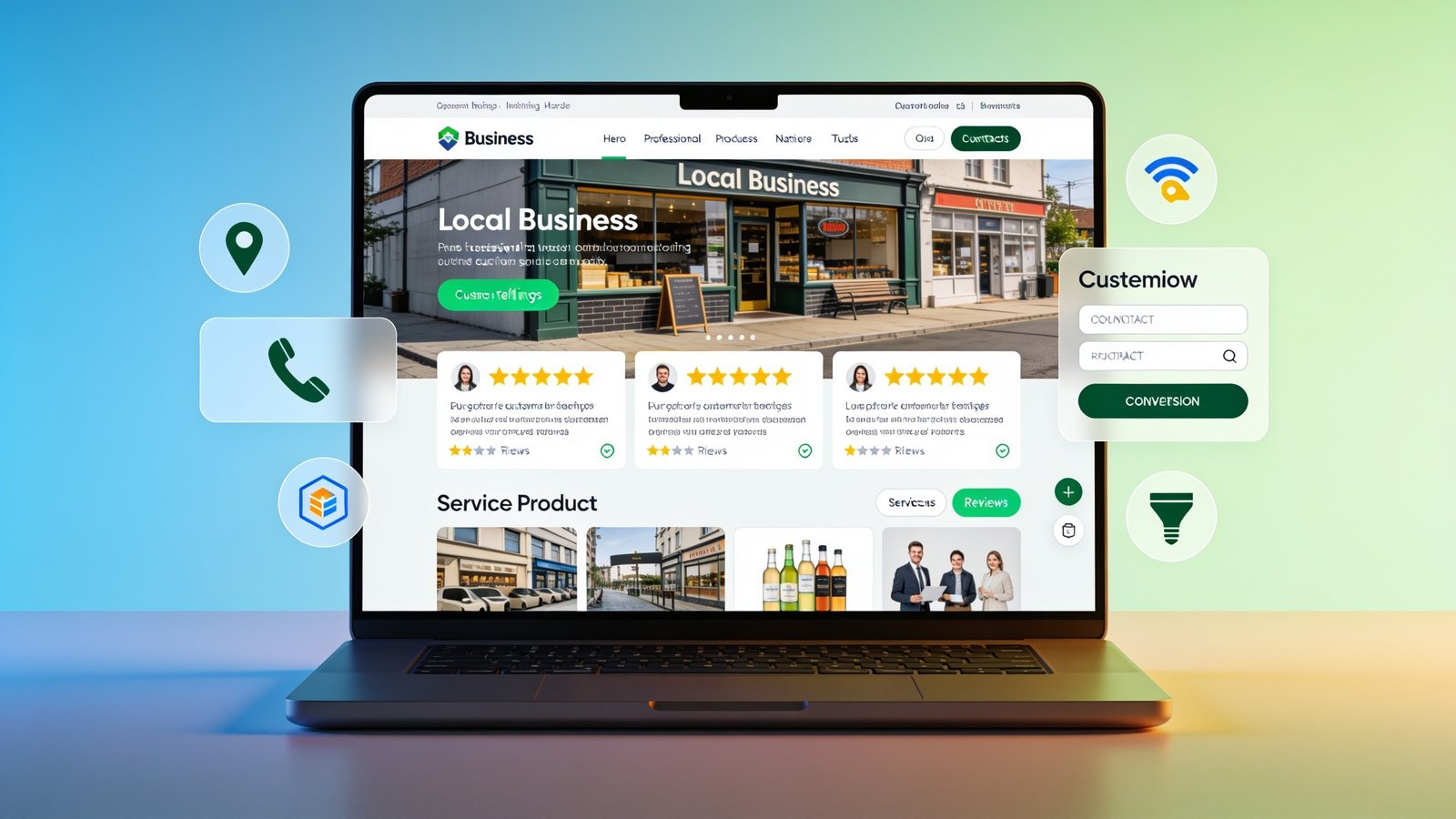
Your hero section has one job - answer "is this the right business for me?" in under five seconds. It should include a concise value proposition, a local visual cue (storefront or neighbourhood photo), a primary CTA (call or book), and trust microcopy (hours, rating).
✅ The Fix:
Lead with a benefit-driven local headline, not a company slogan, and pair it with a CTA that's impossible to miss.
Keep navigation minimal and focused purely on conversion paths: Services, Pricing, Reviews, About, Contact. Good mobile navigation for local websites uses local anchors like "Areas We Serve" and "Emergency Hotline" so visitors immediately know you operate near them.
Well-structured service pages for local businesses use visual cards - a short title, a one to two-line description, a starting price or range, and a micro-CTA like "Book" or "Get Estimate." Add icons and trust badges such as "Licensed," "Same Day," or "Govt Approved," and link out to any online booking systems you use.
Good customer review integration means displaying three to five recent reviews with names, neighbourhoods, and star ratings. Where relevant, embed a short video testimonial, customer testimonials on business websites work especially well as a before/after gallery.
Contact form optimization starts with offering several contact methods side by side - tap-to-call, a WhatsApp button, a short booking form (name, phone, preferred time), and a click-to-get-quote calculator for transparent pricing.
✅ The Fix:
Never make a visitor choose between "call us" or "leave" - give them at least three low-effort ways to reach out.
Build city- and neighbourhood-level landing pages with unique content, FAQs about local regulations or common problems, and structured data for your service area. Link them from the homepage via a map or "Service Areas" section.
A professional local business website still needs a human face. Local customers buy from people, not logos, so show photos of your technicians or staff with names and certifications, add a short local business portfolio showcase of past work, and tell a short story about how the business started in the neighbourhood.
Wherever possible, publish starting prices or price ranges. This filters unqualified leads early and builds trust with the ones who do reach out. Pair it with a clear refund or guarantee policy and terms for emergency visits.
Use an FAQ section to pre-empt objections - turnaround times, warranty, insurance claims, and any relevant precautions. Every FAQ answer should end with a soft CTA nudging the reader toward contact. Here are a few common questions worth answering on your own site:
How do I build a converting local business website?
Start with the fundamentals: a benefit-driven hero, a clear CTA above the fold, real trust signals like reviews and certifications, and a mobile-friendly local business website design that loads in under two seconds. Layer in local landing pages and structured data once the basics are solid.
What are the best website practices for local businesses in 2026?
Mobile-first design, transparent pricing, multiple low-friction contact options, and consistent NAP details across your site and Google Business Profile remain the core best website practices for local businesses in 2026.
Does affordable high-converting website design actually work for small budgets?
Yes - you don't need a large budget to get results. Prioritising the website sections that increase customer conversion (hero, CTAs, trust signals, speed) delivers most of the ROI, even on a lean, affordable high-converting website design.
How do I track local business website ROI optimization?
Track calls, WhatsApp clicks, form submissions, and direction clicks as your core conversion events, then tie them back to cost per lead. This is the simplest way to measure local business website ROI optimization over time.
What actually counts as strong trust signals for a local business website?
Specifics beat generic badges - named reviews tagged with a neighbourhood, verified certifications, and real customer testimonials on business websites (a short video clip or before/after photo does more than a star rating alone) are the trust signals for local business websites that actually move people to enquire.
Does site speed really affect small business growth?
Yes - speed optimization for local business sites isn't just an SEO checkbox, since a slow mobile load loses visitors before they even see your CTA. Getting speed and trust right together is what turns a website design for small business growth from a static brochure into something that actually generates leads.
Use contrast, whitespace, and motion sparingly to direct attention where it matters. Small microinteractions - a subtle check animation after booking, a sticky CTA on scroll, a live chat bubble - increase how responsive and trustworthy your site feels.
Your footer should carry the full NAP, service hours, social links, a brief accreditation list, and a compact sitemap for important landing pages, along with links to your privacy policy and terms of service.
Website performance monitoring means tracking phone calls, WhatsApp clicks, form submissions, direction clicks, Google Business Profile integration data, and heatmaps. Run simple A/B tests on your hero CTA copy, CTA colour, and whether or not to show prices.
A high-converting local business website isn't an accident of good design - it's a deliberate sequence of clarity, trust, and low-friction action, repeated on every page a visitor lands on. Speed optimization for local business sites, real trust signals for local business websites, and a website design for small business growth all matter more than any single visual flourish. Get the hero, the CTAs, the trust signals, and the speed right, and the rest of the site starts working a lot harder for you.
You've just read through the anatomy of a website that actually converts local visitors into customers. Implementing all of it - the local SEO, the CTAs, the trust signals, the speed optimisation - takes time most business owners simply don't have.
That's where we come in.
SGDV builds local business websites optimised for conversion, speed, and discoverability - as a local website design services Bangalore team, we work with SMEs across Southern India and beyond. Whether you're a single-location shop looking into Bangalore business website design or a multi-branch brand exploring SME website development Karnataka, our process stays the same: local SEO best practices, conversion-first visual design, and repeatable builds that don't compromise on quality just because the budget is lean. Over the years that's meant projects for local business websites India-wide - not just Southern India business websites - though Bangalore and Karnataka remain home turf.
What we deliver:
SGDV offers a free website consultation Bangalore businesses (and beyond) can book in 30 minutes, where we'll:
Or call our local support line at +91-824 850 9267. We'll send a short audit within 48 hours after the call. Affordable website design from SGDV runs on transparent, measurable KPIs - leads, bookings, and cost per acquisition - so you only pay for results.